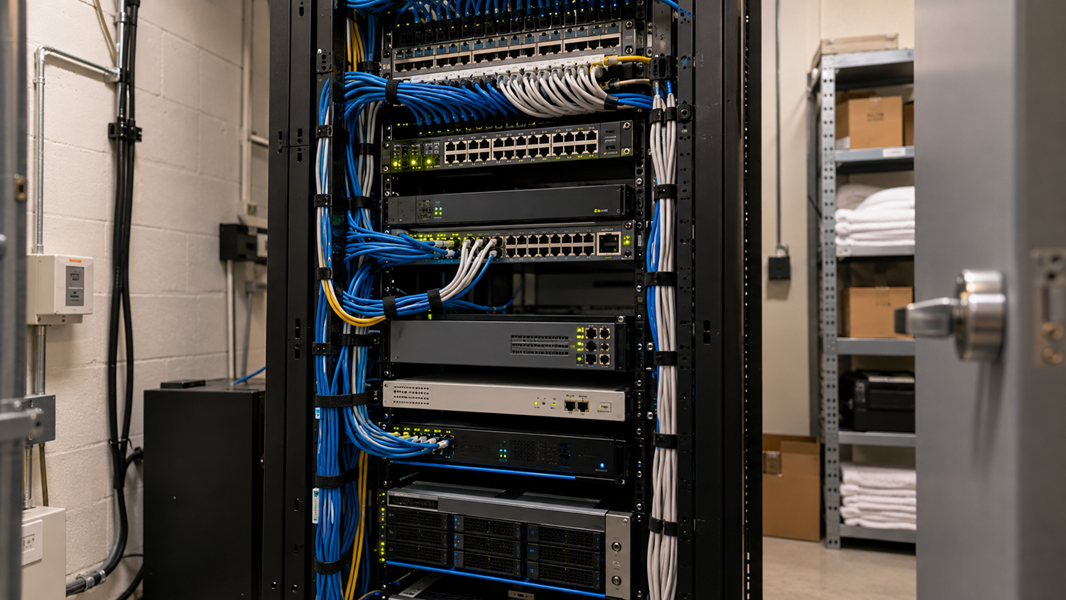
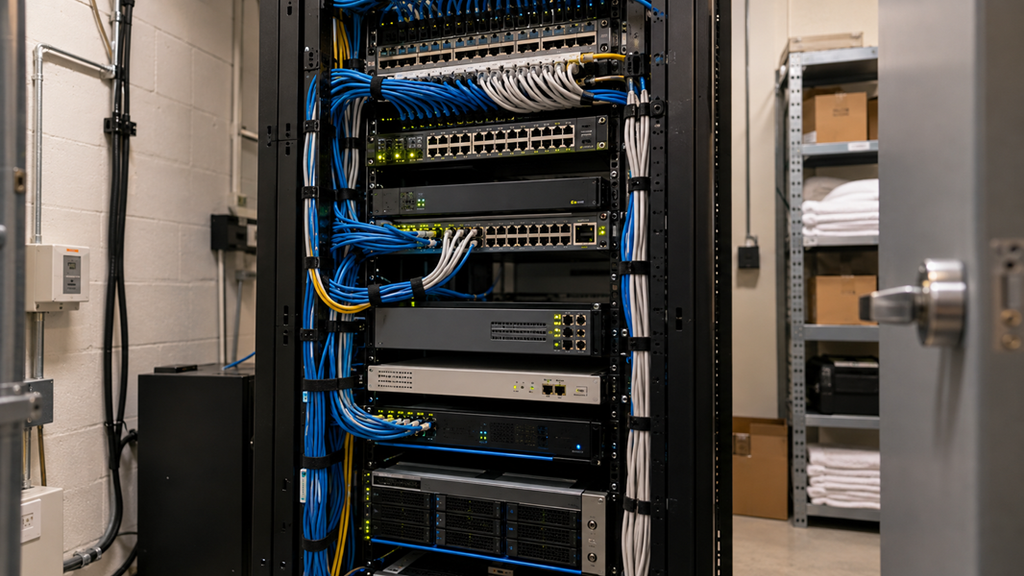
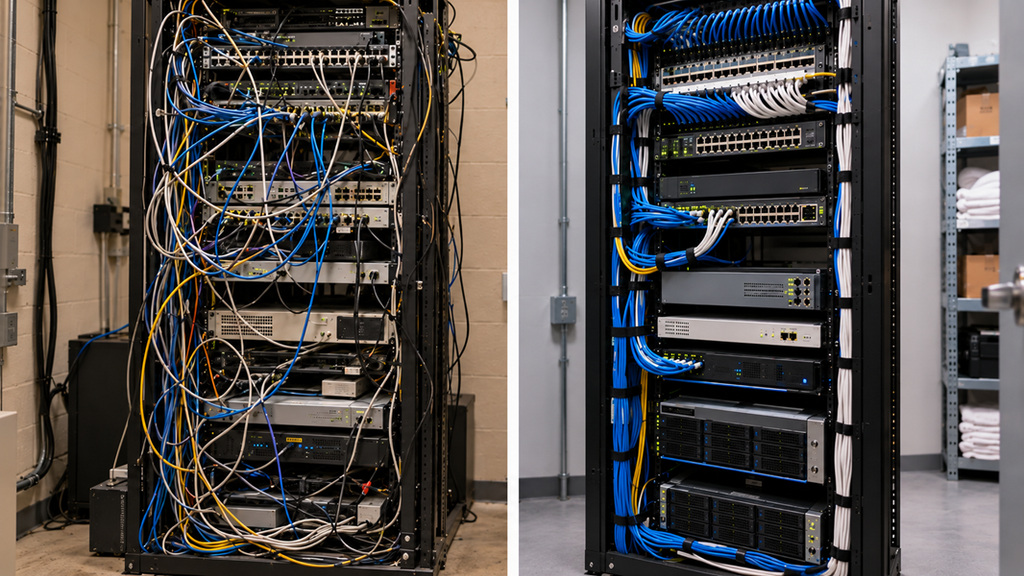
The internal red of a hotelIt is rarely designed all at once. It is more common for it to grow gradually: first, the coverage is expanded. WiFi, Then come the cameras, the new access points, the terminals, the management systems, and increasingly more connected devices. The problem arises when each expansion is resolved in isolation, and the infrastructure ends up becoming a sum of partial solutions that are difficult to manage.
For a time, these “patches” fulfill their function. But as the hotel becomes more reliant on technology, an under-sized network begins to affect performance, security, and the experience for both guests and staff.
What does it mean that a hotel's network has grown based on patches?
Infrastructure grows “in patches” when equipment, wiring, and other components are added., switches,routers or access points without a global planning.
It usually happens naturally: the hotel expands an area, introduces a new service, or urgently needs to solve a coverage problem. A new team is added and everything returns to normal. The risk arises when This process repeats for years without reviewing the complete architecture.
The result is usually a network with devices of different generations, inconsistent configurations, and an excessive reliance on manual adjustments.
What are the signs that the hotel's network needs renovation?
There is no need to wait for a significant drop before taking action. There are several signs that indicate that the infrastructure may have reached its limits.
1. WiFi works well in some areas and poorly in others
One of the most obvious signs is the irregular coverageRooms with good connection and others with weak signal, common areas saturated or points in the hotel where devices lose connection.
It usually results from the fact that access points were installed at different stages, without a joint study of coverage, capacity and interference. In a hotel, it is not enough to simply “have” WiFi”The network must be able to support many users and devices at the same time in a stable manner.
2. Each incident requires a different solution
When each problem requires a specific response, standardization is likely to be lacking. Some common examples:
Restarting certain devices frequently.
Change settings manually.
Use different devices depending on the plant or area.
Maintaining temporary solutions that end up becoming permanent.
Retain old equipment because replacing it would affect other parts of the network.
The more complex the infrastructure is, the more difficult it becomes to locate the origin of each incident.
3. Teams from very different generations coexist
In many hotels, one part of the network has been renovated while another continues to operate with old equipment. This can lead to bottlenecks: installing new WiFi access points It does not improve performance if the switches, links, or cabling that connect them do not support the necessary traffic.
That is why the network must be analyzed as a whole, and not as a sum of independent devices.
What problems can an outdated network infrastructure cause?
The impact goes far beyond just making the Internet work more slowly. Today, much of the hotel operation depends, directly or indirectly, on connectivity.
Unstable performance
If the network is not prepared to handle all the demand, it is normal for there to be slowdowns during peak times. While guests are connecting their mobile phones, computers or televisions, the hotel also needs to have its internal systems continue to function normally.
Greater difficulty in detecting incidents
One red fragmented It is more difficult to monitor. With different teams, configurations, and technologies, finding the source of a problem takes longer. In contrast, a well-designed infrastructure makes it easier. Centralized monitoring and allows for the detection of anomalies before they affect the service.
Security risks
The old networks They can include unsupported devices, legacy configurations, or insufficient segmentation. In a hotel, it is especially important to separate the different types of traffic, such as:
Guest network.
Administrative teams.
Management systems.
Cameras and video surveillance.
IP telephony.
IoT devices.
Maintenance systems.
A correct one network segmentation It helps to limit risks and to control which devices can communicate with each other.
Is your network ready for all the devices that the hotel uses today?
Many hotels designed their infrastructure when there were far fewer connected devices. Today the scenario is very different: mobile devices and guests’ computers are joined by connected TVs, electronic locks, air conditioning systems, cameras, payment terminals, IoT devices, telephony, and internal management systems.
Each new service adds traffic y new connectivity needs. Therefore, a network that worked well a few years ago may not be prepared for current operations.
How do I know if I need to renew the entire network or just a part of it?
Renewing the infrastructure does not necessarily mean replacing all the equipment. The first step should be a network audit that shows the actual state of the installation. A technical inspection can analyze:
The inventory of current equipment.
The age and support of each device.
The capacity of switches and links.
Coverage and WiFi capacity.
The structure of the wiring.
Segmentation using VLAN.
The traffic levels.
The unique points of failure.
The monitoring capability.
The projected growth needs.
With this information, it is possible to decide which elements should be replaced, which can be kept, and in what order it is best to proceed with the renovation.
Why is it important to design the network with growth in mind?
One good infrastructure It must not only cover current needs, but also allow the incorporation of new services without having to rebuild the network every few years. For this, a scalable architecture is needed, with sufficient capacity and homogeneous configuration criteria.
It is advisable to provide for, among other things:
The increase in connected devices.
New WiFi access points.
IoT services.
Audio-visual systems.
Video surveillance.
IP telephony.
Cloud applications.
New areas or expansions of the establishment.
One prepared red By growing, it reduces the need to repeatedly resort to temporary solutions.
What advantages does the planned renewal of the network bring?
Renewing the network in a planned manner can greatly facilitate the day-to-day operations of the hotel and improve the performance of the entire infrastructure. Among its main benefits are:
Greater stability of the connection.
Better coverage and WiFi capacity.
Less points of failure.
Greater visibility of the status of the teams.
Simpler management.
Better segmentation and security.
More capacity to incorporate new services.
Less recurring incidents.
The goal is not to install more technology, but to have a more coherent infrastructure, with greater control and prepared for the actual needs of the hotel.
Is it time to review your hotel’s network?
If each expansion has involved adding new equipment, resolving specific issues, or maintaining old configurations, it’s probably a good time to review the infrastructure as a whole. red hotelier In conditions, it must offer stability, security and sufficient capacity, both for the guests and for the internal systems.
In IPVIP HOTELS We analyze your current infrastructure, identify its limitations, and propose an evolution of the network tailored to the real needs of your hotel. Request a review of your network infrastructure and discover what is failing or what could be improved.
Tell us what you thought of this article. Rate it (1 to 5 stars).