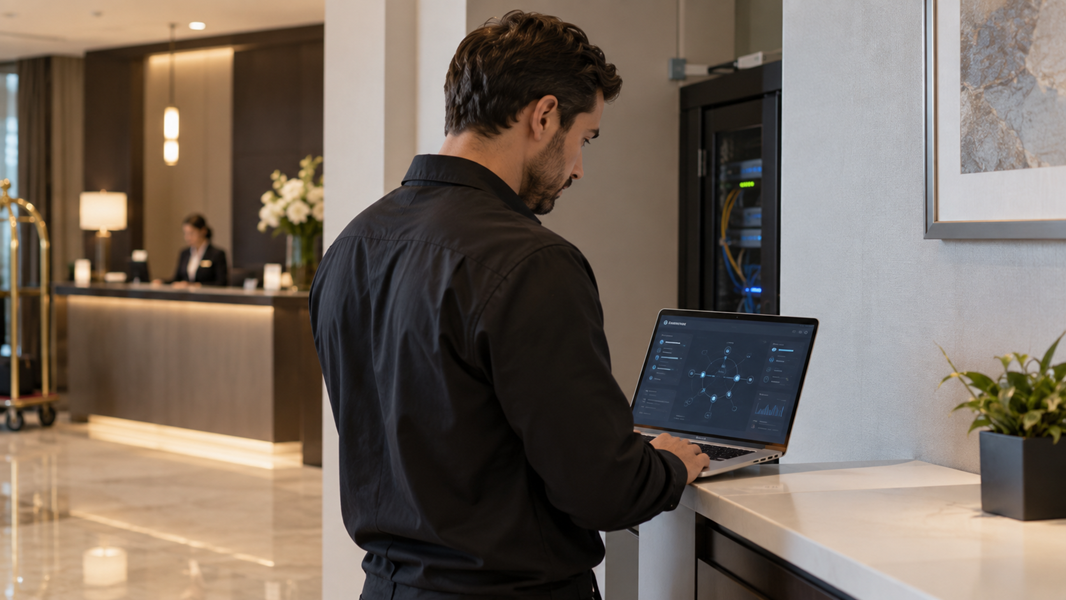
Nowadays, offering an internet connection in a hotel is part of the experience that any guest takes for granted. But having a stable connection is not just about good coverage and speed. It is also essential to have a well-designed infrastructure that keeps the Guest WiFi separated from the corporate network.
Separating both networks improves security, allows for better traffic control, and prevents an issue with the guest connection from ending up affecting the hotel's internal systems.
Guest Wi-Fi and corporate network: two networks, two needs
Although they share the same physical infrastructure, their function is completely different.
The Guest WiFi it is designed to provide internet access to people connecting with all kinds of devices: mobile phones, laptops, tablets, or even IoT equipment. These are external devices over which the hotel has no control.
The corporate network, on the other hand, is the one that connects the equipment and systems necessary for the day-to-day operations of the establishment: front desk computers, management terminals, management systems, staff devices, or internal applications.
Therefore, letting both environments share the same network unnecessarily increases risk exposure.
Why is it so important to separate a hotel's networks?
The network segmentation It consists of dividing an infrastructure into independent environments, defining which devices can communicate with each other and what resources they can access. In a hotel, this is especially important for several reasons.
1. Protect the hotel's internal systems
Every day, dozens or hundreds of different devices connect to the guest WiFi. The hotel does not know how they are configured, what level of security they have, or if any of them are compromised.
If these devices share an environment with corporate equipment, an incident can have a much greater scope.
With a well-segmented infrastructure, a real barrier is created between both networks: guests surf without any problem, but with no possibility of reaching the hotel's internal systems.
2. Reduce the impact of potential incidents
cybersecurity in hotels is not just about preventing an attack from happening, but also about limit its consequences if it happens to occur.
This is where segmentation makes a difference: if a device shows suspicious activity, the problem can be isolated to its segment rather than spreading across the entire infrastructure.
This makes it possible to apply a very simple principle: each user or device accesses only what it truly needs. For example:
The guests They need internet, but no access to internal systems.
The employees they only need the corporate applications they use.
The technical devices They can have their own network.
The mission-critical systems They are kept in specially protected segments.
The better organized the infrastructure is, the easier it is to control these communications.
3. Prevent guests from interfering with hotel operations
Separation also has very practical advantages in day-to-day life.
Throughout the day, there may be times when many guests connect at the same time to stream content, make video calls, or download files. All of this can considerably increase bandwidth consumption.
Without proper management, that traffic could compete with the services the hotel needs to operate. A professional infrastructure makes it possible to establish different priorities and policies for each type of traffic, so that corporate applications always maintain the resources they need, even with the hotel at full occupancy.
4. It facilitates infrastructure control and management
One flat network, where all teams are in the same environment, it is much harder to supervise and manage.
The segmentation allows for a clear view of what is happening in every part of the infrastructure, which facilitates:
Apply different access policies.
Control which devices can communicate with each other.
Set bandwidth limits.
Detect anomalous behaviors.
Independently manage guests, employees, and devices.
Locate incidents much faster.
This organization becomes especially important in hotels with many access points, multiple floors, common areas, or different locations.
Is it enough to have two separate WiFi networks?
No, and it is important to be clear about this.
Having a network called «Hotel Guests» and another called «Hotel Staff» does not guarantee, by itself, that there is a real separation between the two. The differentiation must be made at the infrastructure level, not just in name.
VLAN and logical network segmentation
One of the technologies that make this possible are VLAN, what they believe independent virtual networks within the same physical infrastructure.
Thanks to this architecture, different types of devices can be separated and specific rules applied to each segment. A hotel could have, for example, differentiated networks for:
Guests
Administration and reception
Personal
Technical systems
IP telephony
IoT devices
Furthermore, through firewalls y security policies communications are defined between each of them. The result: a much more orderly, controllable, and secure infrastructure.
The quality of the WiFi also depends on the network design
When hotel Wi-Fi issues arise, the first thought is usually «we need more access points.» But a good connection experience depends on much more than just coverage.
It is necessary to analyze elements together such as:
WiFi coverage in rooms and common areas
Available capacity based on the number of users
Deployment and configuration of access points
Network segmentation
Bandwidth management
Perimeter security
Infrastructure monitoring
Primary connectivity and backup systems
Therefore, an infrastructure specifically designed for the hotel sector must simultaneously cover the guest experience and the business's operational and security needs.
Segmenting the networks, part of the hotel's cybersecurity strategy
The technological evolution of the hospitality sector has multiplied the number of connected systems and devices within hotels. Therefore, hotel network security must be approached globally.
Separating the guest WiFi from the corporate network is a basic measure, but it must be accompanied by proper access configuration, constant monitoring, equipment updates, and threat protection.
A secure infrastructure starts with a well-designed network
The guest needs to be able to connect to the Internet without complications. At the same time, the hotel needs its corporate systems to be protected and to operate stably. Both objectives are fully compatible when the infrastructure is well designed from the beginning.
Do you want to know if your hotel's network is properly segmented? Contact IPVIP y We will analyze your infrastructure to help you build a safer, more stable network prepared for your establishment's needs.
Tell us what you thought of this article. Rate it (1 to 5 stars).